
London to Marrakech: Your Complete Travel Guide (2025)
The Allure of Marrakech from London
There are few journeys that offer such dramatic contrast as the one from London to Marrakech. In under four hours, you swap the grey skies of the English capital for the terracotta rooftops and blazing sun of Morocco’s most captivating city. For Londoners seeking a short-haul escape that genuinely feels like another world, Marrakech delivers on every level.
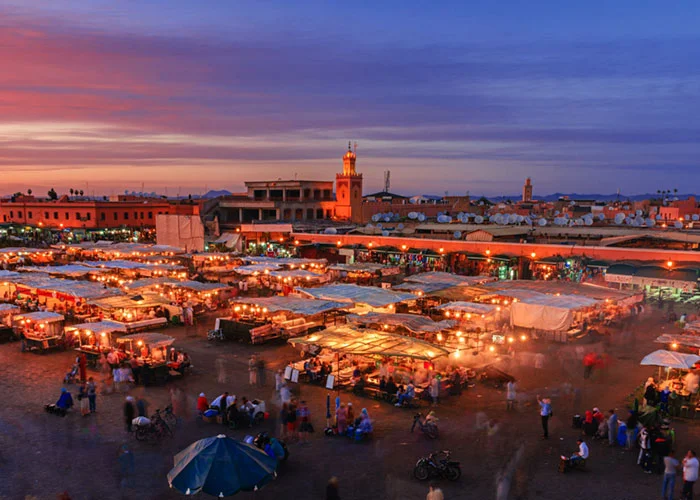
Known as the Red City for its distinctive rose-tinted walls, Marrakech has been drawing travellers for centuries. Its medieval medina — a UNESCO World Heritage Site — pulses with life from dawn until well past midnight. Labyrinthine alleyways open without warning onto ornate palaces, mossy fountains, and souks overflowing with spice, leather, and lanterns. The smell of cumin and orange blossom drifts through the air. Snake charmers and storytellers hold court on the vast Jemaa el-Fnaa square as the Atlas Mountains shimmer in the distance.
What makes Marrakech particularly appealing for UK travellers is sheer accessibility. Direct flights operate year-round from multiple London airports, and the city’s hospitality infrastructure — from budget riads to five-star resorts — is well developed and competitively priced.
Whether you’re planning a romantic weekend or a week-long cultural immersion, this guide covers everything you need to travel from London to Marrakech with confidence. Ready to make it a reality? Explore our 5-day London to Marrakech holiday package from just £490 per person.
Flight Logistics: Getting from London to Marrakech
Getting from London to Marrakech is straightforward, with multiple airlines operating year-round direct routes. The flight takes between 3 hours 30 minutes and 3 hours 50 minutes depending on your departure airport and conditions — short enough to feel like a city break, long enough to arrive genuinely transported.
Airlines Operating the Route
British Airways operates direct flights to Marrakech Menara Airport (RAK) from London Heathrow (LHR), offering a more premium experience with checked baggage included as standard. For budget-conscious travellers, EasyJet flies direct from London Gatwick (LGW) and London Luton (LTN), while Ryanair operates from London Stansted (STN). Air Arabia Maroc offers connecting services via Casablanca for travellers who prefer a flag carrier at a lower price point, though these involve a layover.
London Departure Airports at a Glance
- Heathrow (LHR): Best for west and central London. British Airways direct service.
- Gatwick (LGW): Excellent for south London and the South East. EasyJet direct.
- Luton (LTN): Convenient for north London and the Midlands. EasyJet direct.
- Stansted (STN): Ideal for east London and Essex. Ryanair direct.
Tips for the Best Fares
Book at least six to eight weeks in advance for the strongest prices. Midweek departures — particularly Tuesday and Wednesday — are consistently cheaper than weekend flights. Setting a fare alert on Google Flights or Skyscanner is a reliable way to catch price drops before they disappear.
When comparing low-cost fares, always factor in additional baggage fees, which can significantly narrow the gap between budget carriers and full-service airlines.
Travelling from Other UK Cities?
Marrakech is well-connected across the UK. If you’re based outside London, fully managed holiday packages are available from other major cities — combining flights, hand-picked accommodation, and guided experiences at excellent value:
- Manchester to Marrakech — 5-Day Sahara Desert Package
- Liverpool to Marrakech — 5-Day Morocco Holiday
- Newcastle to Marrakech — 5-Day Desert Holiday
When to Visit: Choosing the Right Season
Marrakech is a year-round destination, but the timing of your visit makes a significant difference to the experience. The city sits on the edge of the Sahara’s climatic influence, which means summers can be punishing and winters pleasantly mild.
Spring (March to May) is widely considered the best time to visit. Temperatures sit comfortably between 20°C and 28°C, the sky is reliably clear, and the gardens — particularly Majorelle and Menara — are in full bloom. This is the sweet spot: warm enough for outdoor sightseeing, cool enough for walking the medina without wilting.
Autumn (September to November) runs a close second. After the intense heat of summer, temperatures ease back into the comfortable mid-20s. October in particular offers excellent weather, fewer crowds than spring, and often lower accommodation prices — a compelling combination for value-focused travellers.
Summer (June to August) brings extreme heat, regularly exceeding 40°C in July and August. Outdoor markets and roof terraces become difficult to enjoy in the afternoon hours. That said, early mornings and evenings remain pleasant, and this period attracts budget travellers prepared to adjust their schedule around the heat.
Winter (December to February) is mild and increasingly popular. Daytime temperatures average 18°C–20°C — comparable to a warm British spring. Nights can be cold, so pack an extra layer. Christmas and New Year breaks to Marrakech have become a firm fixture for UK travellers looking to escape the winter grey.
Entry Requirements: Visas and Passports for UK Citizens
UK citizens enjoy visa-free access to Morocco, making the administrative side of a London to Marrakech trip refreshingly simple.
Passport Validity
Your British passport must be valid for the duration of your stay. Unlike many destinations, Morocco does not require six months of remaining validity — but travelling with at least three months left on your passport is always prudent to avoid any issues at border control.
Arriving in Morocco
On arrival, you’ll complete a standard immigration card, usually distributed on the plane or available at border control. Present your passport, the completed card, and your return ticket if asked. UK nationals are typically granted a 90-day tourist stay automatically.
Documents Worth Carrying
- Proof of accommodation (hotel or riad booking confirmation)
- Return or onward flight ticket
- Evidence of sufficient funds for your stay
Post-Brexit Note
Since Brexit, British citizens continue to travel to Morocco on the same terms as before. The UK–Morocco bilateral travel agreement operates independently of EU arrangements — there is no change to entry rights for British passport holders. Children travelling on a British passport follow the same rules; a letter of parental consent is recommended if a child is travelling with only one parent.
Arriving at Marrakech Menara Airport (RAK)
Marrakech Menara Airport sits approximately six kilometres southwest of the city centre — a short, straightforward journey from the terminal to the medina or the modern Gueliz district.
Clearing Customs
The arrivals process at RAK is generally efficient. After landing, follow signs to passport control, present your travel documents, and proceed to baggage reclaim. Customs checks are routine — declare any large amounts of cash above 100,000 Moroccan Dirhams and avoid attempting to bring in alcohol beyond personal allowance limits.
Currency Exchange
The Moroccan Dirham (MAD) is a closed currency, meaning it cannot be purchased or exchanged outside Morocco. Your first opportunity to get Dirhams will be at the airport exchange bureaux, which are open on arrival. Rates at the airport are reasonable, though slightly better rates can be found at exchange offices in the medina. ATMs are available inside the terminal and accept all major international debit and credit cards.
Getting Into the City
- Petit taxi: The quickest option for solo travellers or couples. Agree on the fare before getting in — fares from the airport to the medina are regulated by local tariffs.
- Bus line 19: The most affordable option, running directly to Jemaa el-Fnaa square. Journey time is approximately 30–45 minutes.
- Pre-booked private transfer: The most comfortable and stress-free choice, especially when arriving late or for the first time. Marrakech Holiday Services can arrange your full airport-to-accommodation transfer as part of a tailored holiday package.
Where to Stay: Authentic Riads vs. Modern Hotels
Choosing where to stay in Marrakech is one of the most enjoyable parts of the planning process, because the accommodation itself becomes a central part of the experience. The city offers two distinct worlds: the centuries-old riad nestled inside the medina walls, and the contemporary hotel rising above the Gueliz skyline.
The Case for a Riad
A riad is a traditional Moroccan house built around a central courtyard — often featuring a tiled fountain, orange trees, and mosaic tilework that has survived centuries of use. Staying in a riad means waking up inside the medina itself, within walking distance of every major souk and landmark. Most riads are intimate, with between four and twelve rooms, and many offer rooftop terraces where breakfast is served as the morning call to prayer fades across the city.
The experience is genuinely immersive. You navigate your own quiet alleyway home each evening, and hosts often double as knowledgeable local guides. For first-time visitors wanting the full Marrakech experience, a riad in the medina is difficult to surpass.
The Case for a Modern Hotel
For travellers who prioritise a pool, a fitness suite, reliable room service, and the consistency of an internationally recognised brand, Marrakech’s newer hotel district — Gueliz and the Hivernage — delivers. Properties here tend to offer larger rooms, higher service standards, and easier access to the city’s restaurant and bar scene.
Which Should You Choose?
If cultural immersion and atmosphere are your priorities, a riad is the natural choice. If comfort and amenities matter more, a modern hotel in Gueliz is a strong option. Many experienced Marrakech travellers split a longer stay between both.
For a fully arranged stay that removes the guesswork entirely, our 5-day London to Marrakech romantic holiday package includes hand-picked riad accommodation, private airport transfers, and guided excursions — from just £490 per person.
Top 10 Things to Do in the Red City
1. Jemaa el-Fnaa Square
The beating heart of Marrakech, this vast open square transforms throughout the day — from a quiet morning fruit market to a full sensory spectacle at night, complete with musicians, food stalls, acrobats, and traditional storytellers. It is the one place every visitor to Marrakech must experience after dark.
2. Majorelle Garden
Created by French painter Jacques Majorelle and later restored by Yves Saint Laurent, this garden is an oasis of cobalt blue structures, rare cacti, and bamboo groves. One of the most photographed spaces in all of Morocco, and a genuinely peaceful retreat from the medina’s intensity.
3. Bahia Palace
A masterpiece of late 19th-century Moroccan architecture, the Bahia Palace features intricately carved cedarwood ceilings, hand-painted stucco plasterwork, and a series of tranquil inner gardens and open courtyards. Entry is inexpensive and the craftsmanship is extraordinary.
4. The Medina Souks
Lose yourself deliberately in the labyrinthine markets fanning out from Jemaa el-Fnaa. Each quarter specialises — leather, spices, textiles, lanterns, carpets — and the sheer sensory overload is entirely part of the experience.
5. Saadian Tombs
Sealed for centuries and rediscovered in 1917, these royal mausoleums showcase some of the finest Moroccan decorative craftsmanship in existence. Modest entry fee, extraordinary interiors.
6. Ben Youssef Madrasa
A former Islamic college dating from the 14th century, this is one of the most beautiful examples of Moorish architecture in North Africa. The carved stucco and intricate zellige tilework surrounding the central pool are breathtaking.
7. Koutoubia Mosque
The 12th-century minaret is the tallest structure in Marrakech and the defining landmark of the city’s skyline. Non-Muslims cannot enter, but the surrounding gardens and the view of the tower at sunset are well worth the visit.
8. Menara Gardens
A peaceful escape from the medina’s intensity — a large olive grove, a serene reflective pool, and a 16th-century pavilion with views stretching toward the Atlas Mountains.
9. El Badi Palace
Once described as one of the most magnificent palaces in the world, the ruins of El Badi are now an atmospheric open-air site — storks nest on the battlements and a scale model of Jemaa el-Fnaa is on display inside.
10. Day Trip to the Atlas Mountains or Sahara Desert
Some of the most memorable moments of a Marrakech visit happen outside the city. The Ait Benhaddou ksar (a UNESCO World Heritage Site), the Ourika Valley, and an overnight Sahara desert camp are all achievable as guided excursions. Marrakech Holiday Services offers fully guided day trips and overnight experiences to all of these destinations.
Cultural Etiquette and Local Customs
Marrakech is a Muslim city, and approaching it with genuine cultural awareness will make your visit both more respectful and more rewarding.
Dress Code
While Marrakech is accustomed to international visitors, modest dress is appreciated — particularly in the medina, mosques, and residential neighbourhoods. For both men and women, covering shoulders and knees is considered respectful. Beachwear is appropriate only at hotel pools and resort properties.
Photography
Always ask before photographing people, particularly market traders, performers on Jemaa el-Fnaa, and local residents. A small tip is customary when someone agrees to be photographed.
Tipping Culture
Tipping is standard and expected. In restaurants, 10–15% is appropriate. Guides, drivers, and riad staff all appreciate a tip at the end of service. Even someone who helps you navigate a tricky medina alleyway will often expect a small dirham note.
Ramadan
If your visit coincides with Ramadan, be considerate. Eating, drinking, and smoking in public during daylight hours is considered disrespectful. Many restaurants reduce daytime service, but post-iftar — after sunset — the city becomes particularly vibrant and welcoming.
Greetings
A warm “As-salamu alaykum” (peace be upon you) is the standard greeting and always well received by locals.
The Art of Haggling: Shopping in the Souks
Shopping in Marrakech’s souks is an experience in itself — but arriving unprepared can mean paying several times the going rate. Haggling is not merely accepted; it is an expected and respected part of the transaction.
The Ground Rules
Prices in the souks are almost never fixed. The first figure offered is an opening position in a negotiation, not a final price. A widely cited starting approach is to counter at around 40–50% of the asking price and work toward a middle ground that both parties find fair.
Practical Tips
- Walk away calmly if you cannot agree on a price. More often than not, the vendor will call you back with a lower offer.
- Shop in the morning — vendors are eager for their first sale of the day and may be more flexible early.
- Carry small-denomination dirhams. Paying with large notes can create awkward change situations.
- Never begin negotiating on something you have no genuine intention of buying. It wastes everyone’s time and creates ill will.
What to Buy
The souks excel in leather babouche slippers, handwoven Berber rugs, argan oil products, hand-hammered metalwork, colourful lanterns, and spices sold by weight. All are excellent value and make authentic gifts.
Dining in Marrakech: A Culinary Journey
Moroccan cuisine is one of the most distinctive and celebrated in the world, and Marrakech is the finest place to encounter it at its best.
Must-Try Dishes
Tagine is the cornerstone of Moroccan cooking — a slow-cooked stew of meat, preserved lemon, olives, and vegetables prepared in the iconic conical clay pot that gives the dish its name. Chicken, lamb, and kefta (spiced meatball) versions are the most commonly found.
Pastilla is one of Morocco’s most remarkable dishes: a sweet-savoury pie of shredded pigeon or chicken, eggs, and almonds, wrapped in wafer-thin warqa pastry and dusted with cinnamon and icing sugar. Unusual, complex, and completely memorable.
Harira is a hearty tomato-based soup enriched with lentils, chickpeas, and lamb — it traditionally breaks the Ramadan fast each evening and serves as a staple comfort food throughout the year.
Couscous is traditionally served on Fridays, piled high with seven vegetables and a rich, ladled broth — a communal dish best enjoyed in a family-run restaurant away from the tourist circuit.
Where to Eat
For the most authentic cooking, seek out small family-run restaurants in medina side streets away from the main tourist routes. Prices are lower, portions more generous, and the food more representative of what Marrakchis actually eat at home.
Jemaa el-Fnaa’s evening food stalls offer an unbeatable atmosphere — stick to stalls with high turnover and visibly freshly prepared food. For a refined experience, rooftop restaurants above the medina combine excellent Moroccan cuisine with panoramic views of the city as the sun sets over the Atlas Mountains.